
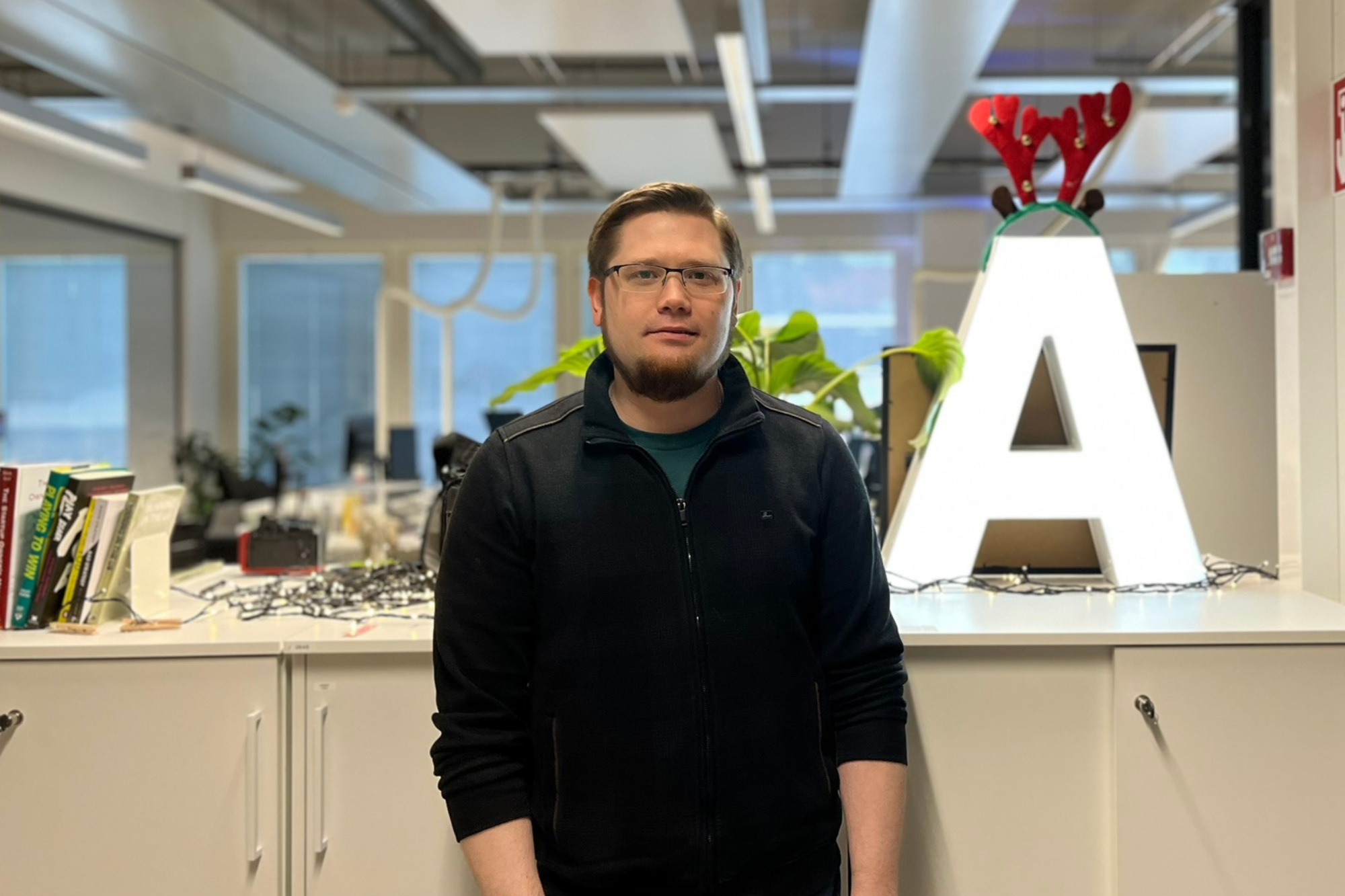
An “As Told To” interview by Kristaps Kovalonoks, Research Coordinator at Aalto University School of Business.
This interview is part of a first-person storytelling series highlighting the journeys, ideas, and insights of members and friends of Aalto University’s Entrepreneurship Unit (ENTU). Real stories, told in their own words.
What does it mean to build entrepreneurial education as a small, startup-like team inside a large university, and to do it in a way that serves students across all six schools? For Kasper Suomalainen, the answer connects directly to his own journey at Aalto: learning by doing, strong community, and an environment where people actively help one another move forward. Now managing the newly launched Aalto Founder School, he reflects on how his relationship with the ecosystem began, what makes Aalto and Finland distinct, and what he hopes the Founder School will achieve in the years ahead.
My name is Kasper Suomalainen, and I am currently the Manager of the Aalto Founder School, which is a new initiative that was set up this past autumn. Before this role, I worked at Aalto Startup Center and in Venture Capital, and earlier on, I was also a student at Aalto.
At the moment, I am fully focused on building the Founder School. The ambition is to make it one of Aalto’s flagship entrepreneurship education programmes. What makes it different from many other initiatives is that it does not sit under any single school. We operate under Aalto’s Vice President of Innovation, which allows us to work across all six schools at the university.
In practice, it means that when there is a problem, it usually ends up on my desk. My role is to help the team and enable them to do the best work they can.
We are a small team, very much like a startup inside the university. Everyone does a bit of everything, from designing and running programmes to very practical tasks around events, including carrying chairs. The core team includes Maija Renko, who leads the Founder Minor, Mårten Mickos as our Entrepreneur in Residence, and colleagues Mara Bande and Tai Tran, who are responsible for Founder Talks and Founder Sprint. The structure is intentionally lean, which allows us to move fast and experiment.
I studied in the Master’s Programme in Entrepreneurship and Innovation Management at Aalto and graduated in 2017. What initially drew me to entrepreneurship was that it teaches highly transferable skills: problem solving, teamwork, selling, and talking to customers. These are useful skills regardless of whether you end up becoming an entrepreneur or not.
The second reason was freedom to explore. I never really felt that I fit neatly into one predefined path. That changed when I walked into the old Startup Sauna building and joined Aalto Entrepreneurship Society (Aaltoes). Everyone there was a bit different, but we shared a builder mindset and a strong sense of curiosity. People were experimenting, trying things out, and having fun while doing so. That was the first time I felt that this might be my environment.
Aalto Entrepreneurship Society was definitely the most important entry point for me. It was the place where entrepreneurship became tangible. Through Aaltoes, I got involved in organising events, carrying chairs, and helping make things happen. That gave me exposure not just to ideas, but to people.
By organising events, you are also exposed to the content and build personal connections with the people speaking at those events. From there, my involvement expanded to Startup Sauna, Slush, and other initiatives in the ecosystem.
I often joke that I might be one of the few people who actually found Aaltoes by googling “entrepreneurship in Helsinki”. This was around 2013. Their website mentioned an open meeting every Tuesday at five o’clock at the old Startup Sauna. I showed up, someone noticed I was a new face, and came to talk to me. That openness is something that stayed with me.
Entrepreneurship is not for everyone, and that is completely fine. We need people in all kinds of professions. But for me, Aaltoes was where entrepreneurship stopped being abstract and became something I could actively participate in.
I do not really think in terms of a single long-term career path anymore. Instead, I think in terms of phases, or chunks of my life. You dedicate several years to something in order to actually create impact.
I spent roughly five years with Aaltoes, Startup Sauna, and Slush, building student-driven initiatives and accelerator programmes. After that, I spent several years in venture capital. Now I am in a phase where I am building the Founder School.
What is particularly exciting this time is that we are working with students who are even earlier than pre-seed. Often pre-idea, pre-team. At that stage, almost anything is possible.
But impact takes time. You cannot build meaningful ecosystems or programmes in six months or a year. You need to commit several years of your life to something if you want it to matter.
One of the earliest examples that comes to mind from my student years is the Startup Sauna accelerator programme. There were three of us students running it at the time, and we scaled it to operate in 35 countries, receiving around 1,500 applications per year.
From those applications, we selected 30 teams annually, 15 in the spring and 15 in the autumn. Percentage-wise, it was actually harder to get into Startup Sauna as a startup than it was to get into Stanford as a student, with all the obvious caveats. But it is still a fun fact.
More importantly, it genuinely felt like the programme had an impact in the regions where we operated, especially between 2013-2017. You could see how knowledge, networks, and confidence were transferred, and how teams and local ecosystems developed as a result.
You see the full spectrum. Companies that grow very quickly, others that grow slowly, some that succeed, some that fail, bankruptcies, and everything in between. You see this not only in early-stage startups, but also in large, well-established companies.
That teaches you is there is no single right way to build a company. If there were, everyone would be a successful entrepreneur. Each founder has to find their own way of working and their own motivation.
When hardship starts and nobody believes in you anymore, motivation has to come from within. If your motivation comes from the outside, you are going to burn out or quit earlier than you would have wanted. That is something I see again and again.
A lot of entrepreneurial knowledge is transferable between countries. What is distinctive in Finland, and especially at Aalto, is the strong pay-it-forward culture. In Finnish, the word is talkoot.
People help because they want to contribute to a shared cause. Entrepreneurs, investors, and mentors coach students at the Founder School pro bono. That level of voluntary contribution is much higher here than in most ecosystems I have seen.
On top of that, Aalto has an unusually high density of talent. You can walk a few minutes on campus and find someone who either has the answer you need or knows exactly who you should talk to. That applies to students, professors, entrepreneurs, investors, and people visiting the campus. The ecosystem is very accessible.
There are two main reasons behind the Founder School.
First, Finland’s startup ecosystem has set a long-term goal of creating 100 companies with 100 million euros in annual revenue by 2050. Aalto has already produced a considerable number of Finland’s unicorn founders. It would be very exciting to say that a large share of future centaur companies also originate from campus. In the long run, one measure of success is how many centaur founders the Founder School has helped produce or coach.
Second, Aalto is positioning itself as a leading European university in innovation and entrepreneurship. Ideally, people would apply to Aalto knowing that their entrepreneurial journey can start here.
If you look at the ecosystem as a funnel, many organisations work with companies that already exist. The Founder School focuses on the very beginning of that funnel: students with ambition, but no idea, no team, and no clear outlet yet. After our programmes, especially Founder Sprint, we want students to feel capable of starting anything: a movement, a podcast, a company, or a high-growth startup. The goal is to raise the overall level of founders entering the ecosystem.
We also benchmark globally. One example we look to is Center for Digital Technology and Management (CDTM) in Munich who have done an amazing job in a few decades. We are still young, and we operate like a startup ourselves. If something works, we do more of it. If it does not, we change it.
Founder Talks are designed to reach thousands of students. The Founder Minor reaches hundreds, and Founder Sprint works with tens of students each year. One of the most positive things we have seen so far is that we are reaching students from all six schools at Aalto. That was an open question early on, but applications and participation have come from across the university. Founder Talks has also reached people beyond Aalto, and the sessions are streamed live on Yle Areena and available via Aalto’s YouTube channel.
Students have found Founder Sprint very challenging. They have had to navigate a pressurised environment, but within the safety of a university setting. We are still learning where the right balance is. Students should not feel too comfortable, rather slightly overwhelmed.
If we look ten years ahead, I would like us to be able to say that Founder School alumni have built companies with real scale and impact. That would mean centaur-level outcomes, but also broader societal impact.
In the first years, success is more qualitative. The stories, the trajectories, and what people who have gone through our programmes have gone on to do. Over time, that can also be reflected in quantitative measures such as revenue, jobs created, and wider contribution to society.
Ultimately, I hope the Founder School becomes something Aalto and Europe can be proud of, and that it plays a role in why people choose to apply to Aalto in the first place.
Talk to customers far more than feels necessary.
There is very rarely harm done by talking to more customers. The more insight you gain, the better you understand them. In the end, whether you aim to build a company with 100 million euros in revenue or a smaller lifestyle business, you are building something for someone else. Understanding their thought process, behaviour, and what they actually value helps you build better products.
Even very large companies fail because they lose touch with their customers. It is rarely just about technology. And one practical thing I have noticed in Finland is that people usually respond. You might get a no, but you get an answer. If you email people, they actually reply, which makes starting those conversations much easier.
One of the biggest values Aalto provided me with was not a single course or event, but the environment itself. Whether through ENTU, Founder School, or student-led initiatives like Aaltoes, the university creates an environment where things can happen.
At the same time, it is up to the individual to make use of it. No one is going to automatically give you value from the ecosystem. What Aalto does exceptionally well is provide a world-class environment. What students choose to do with it is ultimately up to them.