
An “As Told To” interview by Kristaps Kovalonoks, Research Coordinator at Aalto University School of Business.
This interview is part of a first-person storytelling series highlighting the journeys, ideas, and insights of members and friends of Aalto University’s Entrepreneurship Unit (ENTU). Real stories, told in their own words.
What happens when experienced employees still want to contribute, but organisations are not yet sure how to support them? For Thomas Narowetz, Head of Room 466 in Austria, this question became both a professional and personal starting point for the Erasmus+ Senior Talent project. Inspired by demographic change, the retirement of the baby boomer generation, and conversations about purpose later in working life, the project brought together partners from Austria, Finland, Germany, and Latvia to explore how organisations can better support senior talent, knowledge transfer, and late-career development. In this interview, Thomas reflects on the origins of the project, the value of European collaboration, Aalto University’s role as research lead, and why age diversity should become part of every organisation’s strategic agenda.
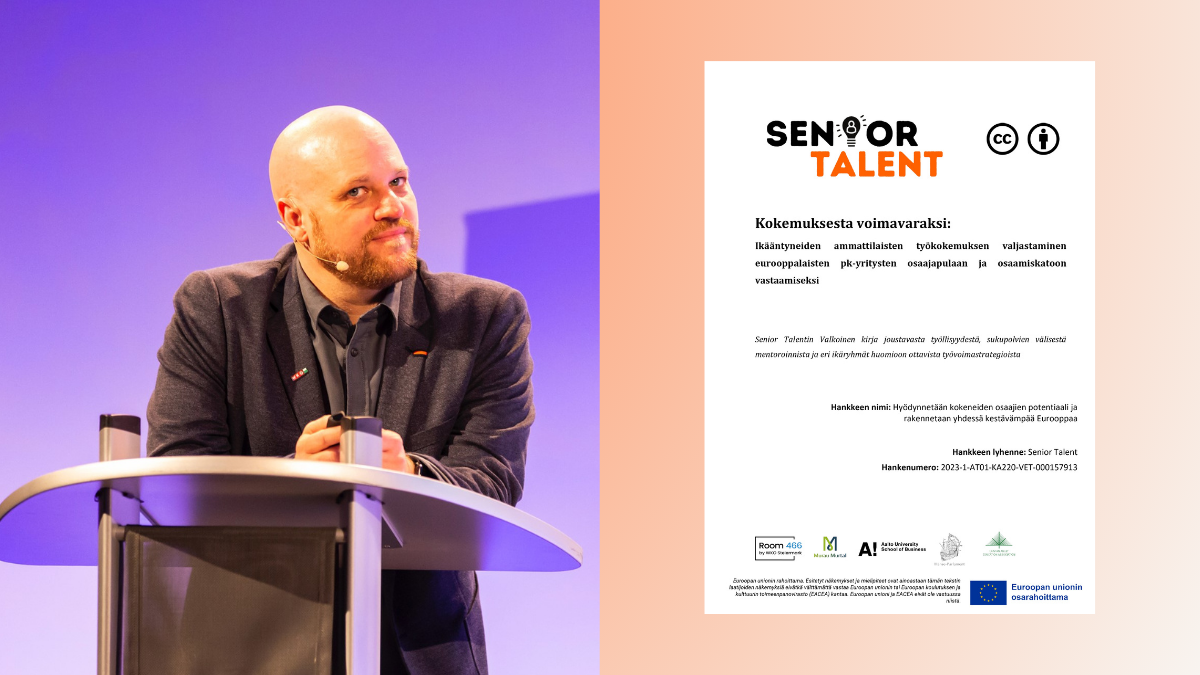
My name is Thomas Narowetz, and I am Head of Room 466, the research and development department within the education unit of the Styrian Economic Chamber. In Austria, we have a regulated chamber system, where each region has its own chamber. I work in Styria, in the south-east of Austria, and we are based in Graz.
In the Senior Talent project, I had the final responsibility from our department’s side. I was also involved in the project implementation, especially in connecting the project with the Chamber Management Board, the management of the Vocational Training Institute, and our Styrian partner organisation, Regional Development Agency Murau Murtal.
There were different reasons why we developed and applied for the Senior Talent project. One important factor was the ongoing retirement of the baby boomer generation. This creates a workforce gap, but it also means that organisations risk losing a lot of knowledge, experience, and know-how.
The main idea was to explore how we can support the employability of senior talents during their late-career phase and beyond. How can we motivate people to continue developing themselves and planning their work future when they are in their 50s? And how can we encourage them to think about remaining active also beyond retirement age?
There was also a personal story behind it. A few years ago, my colleague Verena Maier and I were on a business trip in Rijeka, Croatia. It was almost 40 degrees outside, and over a drink we started discussing possible project ideas. Verena mentioned that her parents were approaching retirement, but did not really seem to want to retire in the traditional sense. They still wanted to remain active and continue contributing in some way.
I recognised something similar in my own family, but from two very different perspectives. My mother retired as a teacher and has sometimes looked for a new sense of purpose after working life. My father, on the other hand, retired from his employed role as a doctor but continued working through his own practice. Seeing these different experiences made us realise that retirement is not one simple transition. For many people, the question is not only when work ends, but how they can remain active, valued, and connected afterwards.
The partnership was a mix of partners we already knew and partners who brought something specific to the topic. Hanse-Parlament was an experienced partner we had collaborated with before, so we knew that the cooperation would work well. We also wanted a regional perspective, which is why we invited Regional Development Agency Murau Murtal. We did not want the project to focus only on cities or metropolitan areas, but also on rural areas.
The connection to Aalto University came through Ewald Kibler, who is an old friend from university. I knew that he had been working with questions around late-career entrepreneurship, and although Senior Talent was not only about entrepreneurship, the broader topic of late-career employment and development felt like a strong fit. We also wanted to give the project a solid scientific foundation, and Aalto brought that dimension.
The connection to the Latvian Adult Education Association came through Hanse-Parlament and its wider Baltic Sea region network. In the end, we had Austria, Germany, Finland, and Latvia involved. We also did not want the consortium to become too large. In a European project, it can be tempting to include many partners, but a smaller consortium is often easier to manage and makes real collaboration more possible.
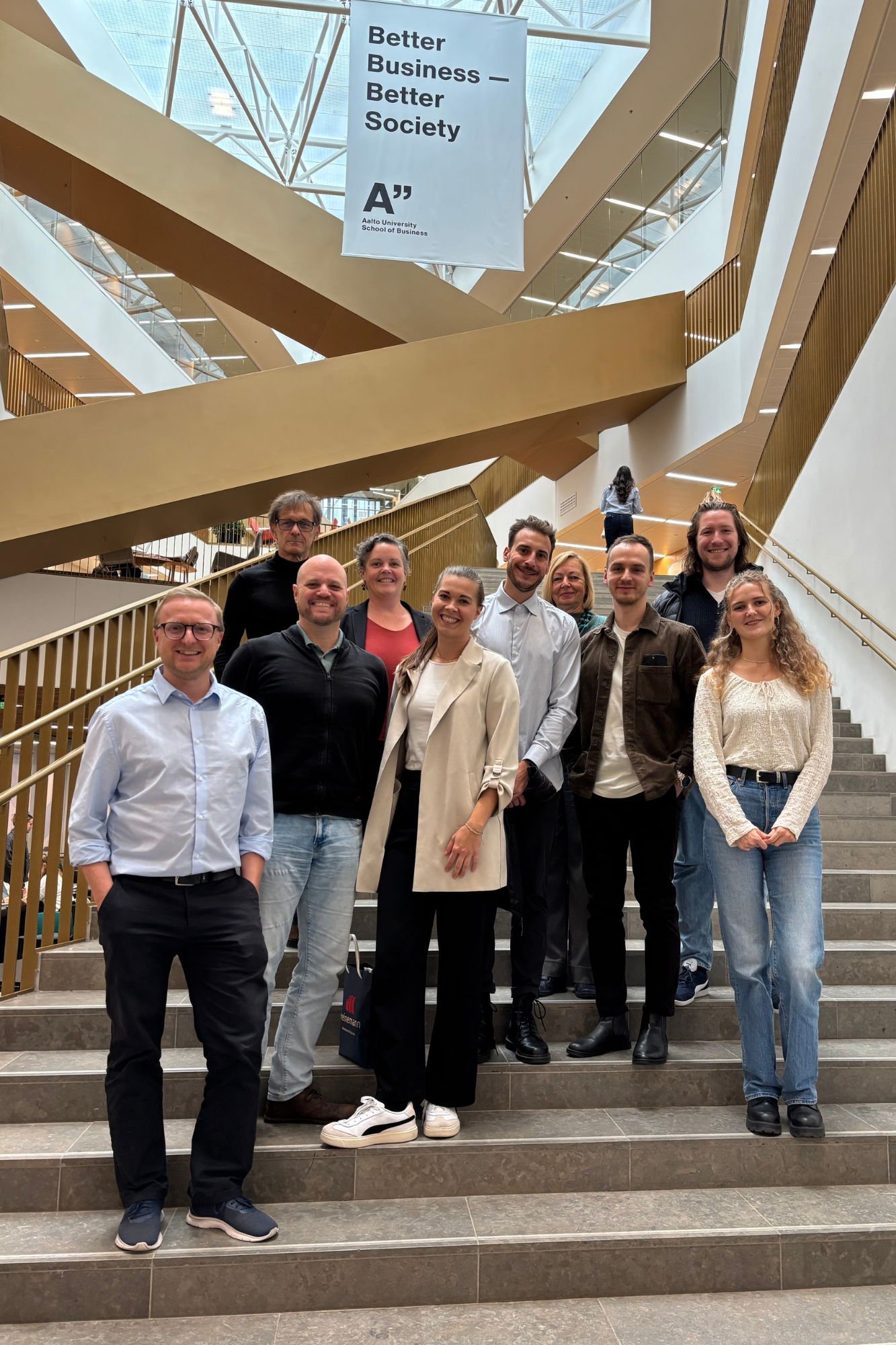
Overall, it was a very positive and empowering experience to collaborate with Aalto. At the beginning, there was a kind of synchronisation phase where we had to align expectations, project needs, and scientific standards. We needed to find a research approach that worked both for the project and for Aalto’s academic expectations.
I remember discussing the project idea with Ewald before we applied for the funding, and one interesting point for Aalto was the possibility to work on something more practice-oriented. This was not a purely scientific project, like a Horizon Europe research project. Erasmus+ opens the door more strongly to vocational education and training, and also to the business world.
For me, this kind of cooperation between universities, VET institutions, and business representative organisations is very important for the future of education in Europe. Scientific knowledge should not stay only at the scientific level. It should also find its way into vocational education, training, and practical application in companies.
One of the key insights for me is that many senior employees will continue to work if their job remains enjoyable, purposeful, and socially valued. If I had to put it very simply, I would say: take an individual approach and talk to your senior employees.
That means taking their individual wishes and needs seriously. It also means starting these conversations early enough. Not only when someone is already 55 or close to retirement, but earlier, perhaps already in their 40s if it is a long-term work relationship.
Another important point is knowledge transfer. If a company agrees on a development path with an older employee, that path should also include knowledge transfer goals. This could happen through mentoring, through a specific knowledge transfer project, or through another format. The important thing is to think consciously about what knowledge and experience should be passed on or preserved.
For me, one of the most interesting questions was whether older employees would actually see the need for the kind of professional development offer we created. As part of the Senior Talent Training Box, we developed two pilot trainings: one on mentoring and another on employment options after retirement. In the project application, the second concept was called Employment Options After Retirement, but for me it was always broader than that. I saw it more as a professional development concept for senior employees.
I was not sure whether people would feel that they needed it. Sometimes people do not recognise a need until there is a concrete offer in front of them. What surprised me was that when we tested this workshop with unemployed people from an outplacement organisation in Graz, it seemed to come at the right moment.
Some of the participants had lost their jobs shortly before reaching retirement age, and the feedback was mostly very positive. That showed me that an idea can make sense on paper, but the real question is always whether the target group accepts it and whether the timing is right.
We are already connecting with organisations that might have an interest in continuing to use the project results. One example in Austria is ASEP, the Austrian Senior Experts Pool, which has around 200 senior experts who offer their expertise to others, sometimes for free and sometimes at below-market prices. We are discussing whether our results could be useful for their internal work, their services, or even a future project.
Another possibility is to turn the training concepts and materials we developed into concrete offers for the professional development, vocational education, and training markets. That would help the project continue beyond the funding period.
I also see potential in developing a new project around intergenerational collaboration, innovation, knowledge transfer, and the use of artificial intelligence. In this context, AI is only an instrument, but it could help with one of the classic challenges in knowledge management: how to make implicit knowledge visible. Experienced employees carry a lot of knowledge that is difficult to capture. In the future, these tools might help organisations process different kinds of information and make that knowledge more tangible and accessible.
I would borrow a thought from my colleague Günter Leitner, the CEO of Regional Development Agency Murau Murtal. He said that company leaders simply need to start putting the development of older employees and age diversity onto their agendas.
That means putting it on management agendas and business strategy agendas, and taking it seriously. Organisations do not need to solve everything immediately, but they need to start somewhere.
So my advice would be: put the topic on the agenda, look at the Senior Talent project results and white paper, and take the first step by talking to your senior employees about their development plans.
I would also add that this is exactly why collaboration between universities, vocational education and training institutions, chambers, and business-facing organisations matters. If research stays only at the university level, its impact is limited. But when scientific knowledge is connected to training, business support, and company practice, it has a much better chance of reaching the people and organisations who can actually use it.
Funded by the European Union. Views and opinions expressed are however those of the author(s) only and do not necessarily reflect those of the European Union or OeAD-GmbH. Neither the European Union nor the granting authority can be held responsible for them.